
Syria-Lebanon Partnership Brings Hope
By Courtney Ellis

The Syrian Presbyterian Church Community that met at Church of the Covenant in Costa Mesa
The Syria-Lebanon Partnership Network connects pastors and churches in the Middle East with American counterparts for prayer, fellowship, and support. Intentionally two-sided, it fosters communication and community between Presbyterians facing unique challenges while seeking to follow Jesus faithfully in their unique contexts.
When Tim McCalmont could begin to see his road to retirement from the pastorate at Presbyterian Church of the Covenant in Costa Mesa, God was far from through with him.
“I didn’t know much about Syria,” said McCalmont. Then a family from Homs, Syria–the Jarjours–immigrated to Costa Mesa. They had worshiped in a Presbyterian church in Syria, so they looked for a Presbyterian Church here.
“Their daughter preceded them,” said McCalmont. “She was an operatic soprano and she landed in our choir.” When she heard her parents were coming to America, she told them to come join her at Presbyterian Church of the Covenant. McCalmont soon found himself captivated by their story–particularly the faithfulness of their church in Homs amidst an incredible struggle. McCalmont asked for their pastor’s contact information so he could offer to partner with him in prayer. Rev. Mofid Quarijilly and McCalmont quickly struck up a friendship, and a deepening in McCalmont’s heart for the plight of the people of Syria.
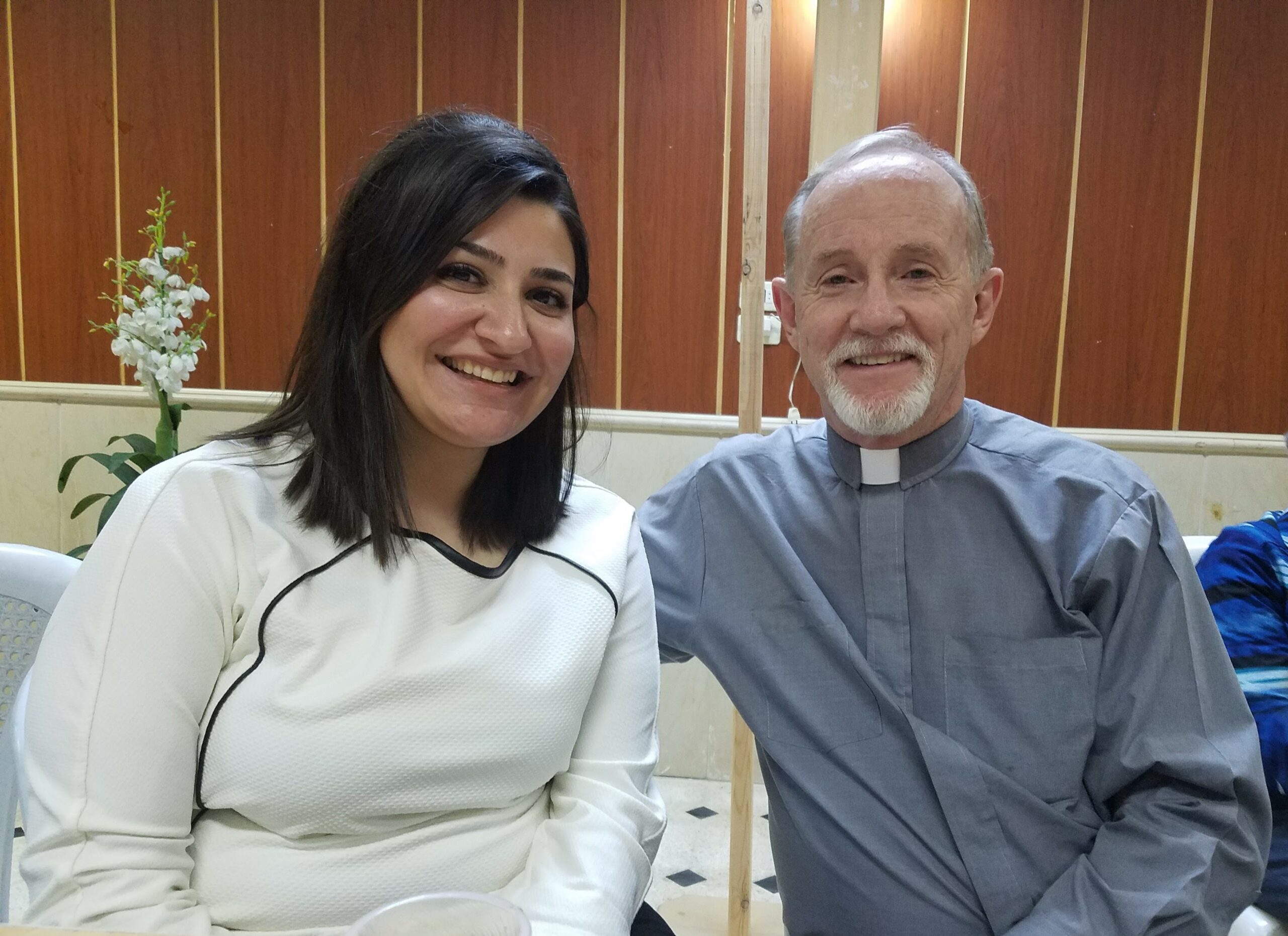
Rev. Tim McCalmont with Mathilde Sabbaugh, pastor of the National Evangelical Church in Hasekah, Syria
The more he learned, the more connections he noticed with his own Presbyterian faith. “This is the 200th anniversary of Presbyterian mission in that part of the world,” said McCalmont. “The American University of Beirut was started by Presbyterian Missionaries. It’s known as the Harvard of the Middle East. Lebanese-American University was started by Presbyterian missionaries who wanted to have a school for women.”
McCalmont’s journey took him to Louisville, where he and Arfan Jarjour, one of his new Syrian congregants, went to a convening conference for what was then called The Syria-Lebanon Mission Network. He planned to sit in the back and simply listen and learn. As is often the case, God had other plans. One thing led to another and within a few years, McCalmont found himself as the moderator of the newly renamed Syria-Lebanon Partnership, a position he held for six years.
Over that time he visited Syria and Lebanon several times, gathering new information and friendships each time. On one visit, “We drove through the city of Homs and it was like those pictures you’re seeing from the Gaza strip. Buildings were just pancaked and the streets were full of debris. It was unlike anything I’ve ever seen.” One of the churches he hoped to see had been bombed to rubble, its congregation now worshiping in a nearby senior center. During the height of the war, millions of Syrians were pushed into refugee camps in Lebanon.

A work of scared art carved from a dead tree in Lebanon
“We went to a refugee camp and just interacted with families,” said McCalmont. “I went to one camp where there were…three generations huddled in this tent and the grandfather came out and asked if I would come in and pray for his granddaughter who was just diagnosed with a malfunctioning artery to her heart. So I went in and the family gathered around her and I remember praying for this little girl. And they were Muslim. I prayed, you know, as a Christian pastor, and they were so grateful.”
McCalmont spoke of visiting the schools the Presbyterian Synod of Lebanon set up for refugee families. “The synod was actively involved in providing food and medical supplies and heating oil and all the rest of this stuff for the refugees, but what do you do with the kids?” he asked. “So through the churches they started these learning communities for kids where they’d pick up the kids in the camp, bus them to the facility in or near the church, and they’d give them clothing and food and give them four or five hours of schooling each day. And one of the things that they really know how to do over there, the Presbyterians, because of the Presbyterian Missionaries that went over there 200 years ago with an emphasis on hospitals and churches–they know how to set up schools! The parents were blown away by the education they were getting.”
In partnership with the Syria-Lebanon Network, six schools were started, with a couple hundred children in each. “[The money] we raised over time helped pay for that,” said McCalmont.
At times, the ministry overwhelmed him. “I remember sitting in the airport on the tarmac in Beirut,” he said. I just sighed deeply and said, ‘God, what am I supposed to do with this?’ It was just so much. I knew I was there because he had arranged for me to be there, but I didn’t know what the heck I was going to do with all that stuff.” In the midst of a busy airport, a message.

Tim McCalmont preaching at a Syrian Presbyterian Church with Noura Eid, a recent graduate of the Near East School of Theology, now a D.Min student at Columbia Theological Seminary in Decatur, GA
“I remember hearing a message that was very clear,” said McCalmot, “and it was ‘Just do what I am bringing you to do.’ So I flew back to the U.S. and to Costa Mesa and I shared my experience with the church, with the family that I had first gotten interested with, and soon others they’d gotten in touch with here came by and we started a Syrian Presbyterian Church Community. It wasn’t really a church plant but it was a group of Syrians who were here, who were Presbyterians when they were in Syria but were here now and wanted to worship.”
Adel Malik assisted in this ministry, noted McCalmont. “They had Arabic services in our sanctuary on Sunday afternoons, and Adel would preach for them.”
Between trips to Syria and Lebanon, there was much more work to do back home in America. “We started speaking around the country and raising money and working with other NGOs to collaborate on how we address all of this,” said McCalmont, noting that he recently returned from a trip to Washington D.C. to advocate before national legislators for the people of Syria and Lebanon. “We’ve made it through the military part of the war,” he said, “and when ISIS kind of went down, it was kind of like, ‘Boy, how do we help our people now recover from this?’”
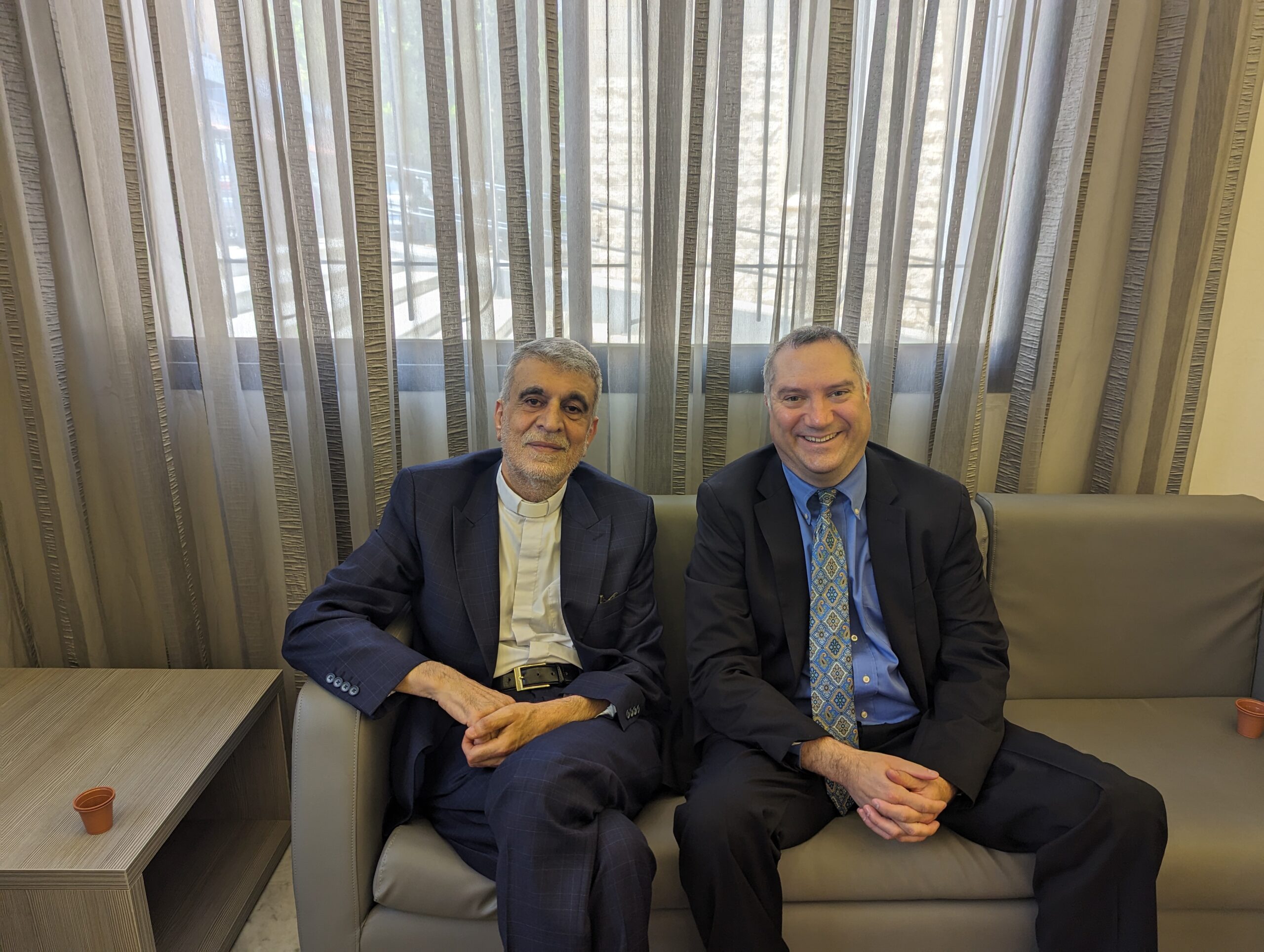
Rev. George Mourad of National Evangelical Presbyterian Church in Rabieh, Lebanon with Rev. Jonas Hayes
Jonas Hayes, pastor of Grace, First Presbyterian, partners with Rev. George Mourad of National Evangelical Presbyterian Church in Rabieh, Lebanon (suburban Beirut). It is the closest Presbyterian Church to where Kay and Wadih Semaan, his own church members’, lived in Lebanon.
“It is encouraging to partner in prayer with a pastor of a church in such a different setting from my own,” noted Hayes. “Rev. Mourad is a very gifted pastor and leader… When I visited his church, I was moved by the loving interactions I witnessed in the church family members and their engagement and interest in welcoming me.”
During a time when the Middle East is in the news daily, with tragedies growing heavier by the day, “This relationship has personalized the events in the Middle East,” wrote Hayes. “This is one of the most meaningful ministries I have ever been involved in.”
Several other pastors within our Presbytery are connected to the Syria-Lebanon Partnership, praying with pastors halfway around the world.

Tim McCalmont and Joseph Kassab, the General Secretary of the National Evangelical Synod of Syria and Lebanon
If you or your congregation are interested in learning more or getting involved in this important ministry, Tim encourages you to reach out. “Contact me anytime!” he said, noting that much of his retirement time goes to speaking with pastors, mission committees, and churches. He loves that it’s a ministry that goes far beyond money. “If you try to just raise money, people don’t respond,” he noted. “Here is a real way you can get involved with real people and know and communicate with those people. I didn’t get started because I was impressed by an institutional advertisement. I started because I made a friend.”
Contact Tim or visit the network’s website.
Highlights from the Syria Lebanon Partnership Network’s Latest Newsletter
 Courtney Ellis, Associate Pastor at Presbyterian Church of the Master in Mission Viejo, is an author and storyteller. Courtney will be reporting over the next few months on the presbytery’s mission partnerships.
